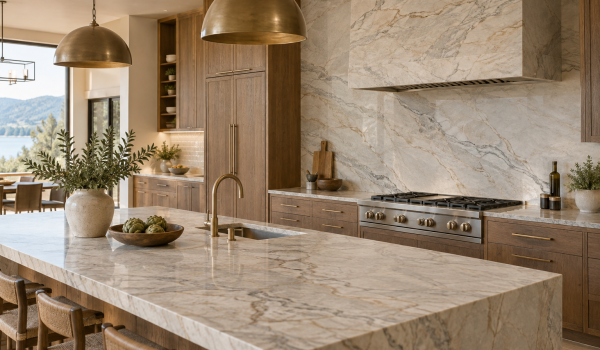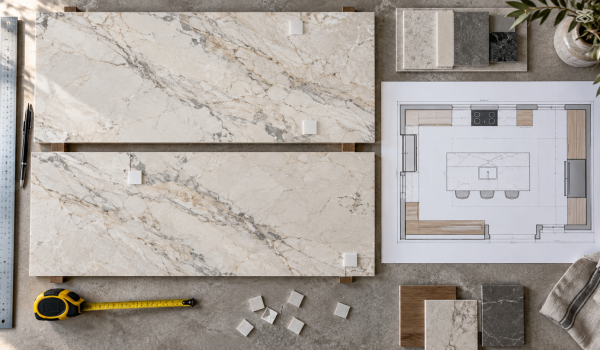
Stone slab thickness affects more than the profile you see at the countertop edge. It can influence weight, support, fabrication, edge design, transportation, installation, and how the finished surface relates to cabinets and surrounding materials.
Two centimeters and three centimeters are common nominal thicknesses, but neither is automatically the better choice. The right specification depends on the stone, application, design intent, available slabs, and the fabricator’s engineering and installation plan.
What Do 2cm and 3cm Mean?
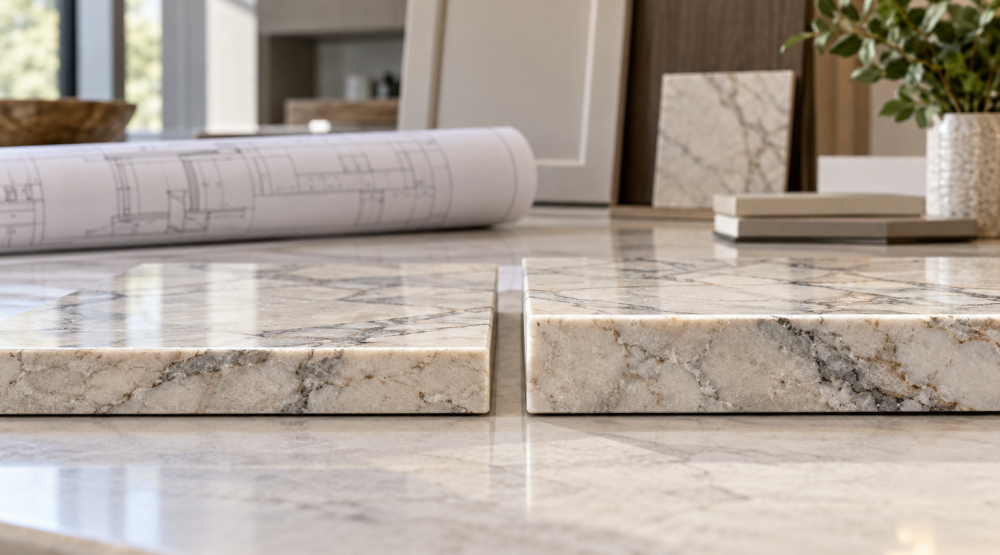
The measurements describe the nominal thickness of the slab: 2 centimeters is approximately three-quarters of an inch, while 3 centimeters is approximately one and one-quarter inches. Natural material and production tolerances mean an individual slab may not measure exactly the same at every point.
The Natural Stone Institute’s technical resource library addresses slab-thickness tolerances, countertop support, and related fabrication questions. Final decisions should be made with the fabricator using the exact stone and project conditions.
How Thickness Changes the Finished Appearance
A 3cm slab naturally creates a more substantial visible edge. In many countertop installations, that thickness can provide a clean, solid profile without building up the edge.
A 2cm slab has a slimmer profile that can suit refined, contemporary, or vertically oriented applications. Fabricators can also create laminated or mitered edge assemblies when a thicker visual effect is desired, subject to the material, design, and fabrication method.
Edge appearance should be considered alongside cabinet proportions, appliance heights, backsplash conditions, and the overall architecture of the room—not as an isolated detail.
Weight, Handling, and Support
Thicker stone generally weighs more per square foot, but the project cannot be engineered by thickness alone. Stone type, span, cutouts, overhangs, seams, cabinet construction, substrate, and installation conditions all matter.
A thinner slab may require a different support strategy in a horizontal application. A thicker slab is not permission to ignore structural review. The fabricator and other responsible project professionals should determine support, reinforcement, transportation, and installation requirements.
Countertops and Islands
Both 2cm and 3cm material can appear in countertop work depending on regional practices, the selected stone, and the fabrication system. A large island, long run, sink cutout, cooktop, waterfall edge, or extended overhang can change the recommendation.
Before reserving material, review how kitchen slab quantity is determined. Slab dimensions and thickness should be considered together because the most visually appealing material still needs to yield the required pieces safely and efficiently.
Waterfall Edges and Mitered Details
Waterfall panels and mitered edge assemblies can create the appearance of a thick, continuous mass. Their success depends on precise fabrication, strong color and vein coordination, appropriate support, and careful installation.
Directional slabs may require additional material to preserve movement across the joint. A bookmatched or vein-matched stone layout should be planned before cutting rather than treated as a finishing adjustment.
Backsplashes, Walls, and Fireplace Features
Vertical applications introduce different handling, anchoring, substrate, and load considerations than countertops. A slimmer slab may reduce weight, but that does not remove the need for an appropriate installation system.
Fireplace surrounds, feature walls, shower panels, and commercial focal points should be reviewed for their specific substrate, environmental exposure, codes, and manufacturer requirements. For inspiration, see our guide to using statement stone beyond countertops.
Does Thickness Change Stone Performance?
Thickness is only one part of performance. Mineral composition, natural fissures, reinforcement, cutout placement, span, edge geometry, finish, fabrication quality, and installation all affect how a finished assembly behaves.
The Natural Stone Institute’s homeowner countertop guide notes that slabs used together must be coordinated for thickness and installed within appropriate tolerances. This is another reason to have the exact slabs reviewed as a group.
Questions to Ask Your Fabricator
- Which thicknesses are available in the exact material and bundle?
- Which thickness is appropriate for the intended application?
- What support or substrate will be required?
- How will the chosen thickness affect edges, seams, and appliance clearances?
- Can the planned waterfall, backsplash, or bookmatch be cut from the available slabs?
- Who will verify field conditions before fabrication?
Choose Thickness as Part of the Complete Design
Start with the exact stone, the application, and the visual goal. Then let the fabricator evaluate thickness together with dimensions, support, seams, cutouts, and installation access. Choosing 2cm or 3cm in isolation can overlook the conditions that matter most.
Explore Terra Stone Gallery’s current slab inventory. Builders, architects, and trade professionals can also review the contractor and wholesale resources. To discuss available materials for an upcoming project, contact Terra Stone Gallery.