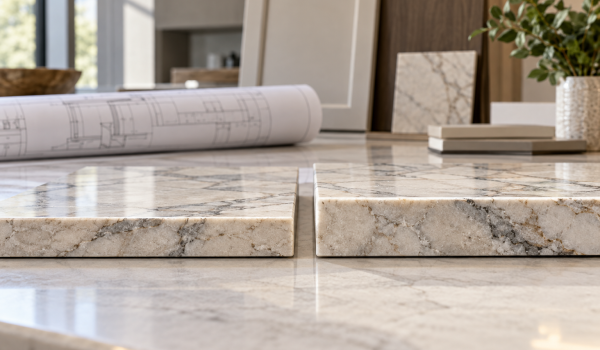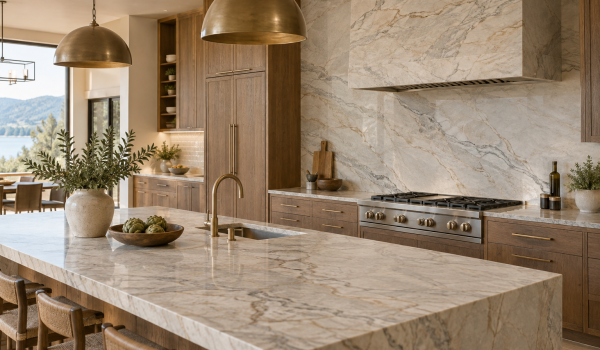

Dolomite and quartzite can both bring natural movement, depth, and one-of-a-kind character to a kitchen. They are not interchangeable, however. Their mineral composition, response to everyday use, and care expectations can differ, and even stones sold under the same general category can vary.
The short answer is that quartzite often appeals to homeowners prioritizing a hard, quartz-rich natural surface, while dolomite can offer marble-like beauty with properties that differ from traditional calcite marble. The right choice depends on the exact slab, finish, application, and how you expect the kitchen to age.
What Is the Difference Between Dolomite and Quartzite?
Quartzite is a metamorphic rock formed when sandstone is transformed by heat and pressure. The Natural Stone Institute’s quartzite overview explains that quartzite can have exceptional strength, density, and hardness. Those properties are tied to its quartz-rich composition and geologic formation.
Dolomite is a carbonate-based stone containing calcium-magnesium carbonate. According to the Natural Stone Institute’s discussion of dolomitic stone, dolomites generally have higher density, lower absorption, and greater strength and abrasion resistance than calcium-carbonate-based limestones. That does not make every dolomite identical or suitable for every countertop; it means the mineral composition matters when evaluating performance.
How Their Appearance Compares
Many dolomite slabs feature soft white, cream, or gray backgrounds with flowing veins that can resemble marble. The look can be elegant and restrained or highly expressive depending on the quarry and block.
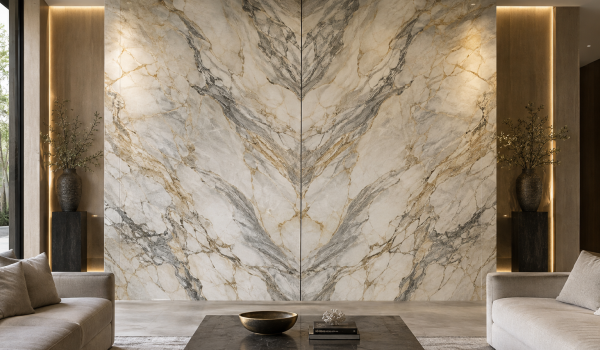
Quartzite offers an equally broad visual range. Some slabs are quiet and tonal, while others contain strong diagonal movement, crystalline areas, saturated color, or dramatic contrast. Terra Stone Gallery’s quartzite slab collection shows how different individual slabs within one stone category can be.
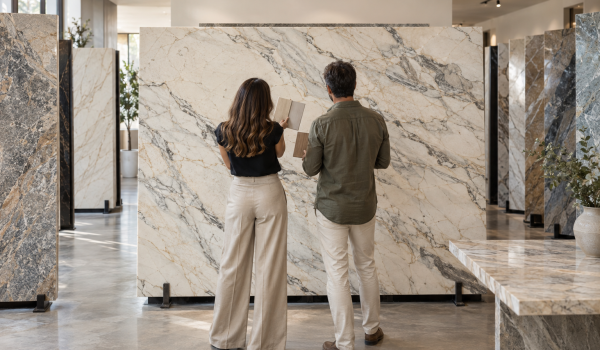
Do not make the decision from a name or small sample alone. View the full slab and compare its dominant color, undertones, movement, finish, and natural characteristics. Our guide to selecting a natural stone slab in the showroom explains what to bring and what to inspect.
Scratch and Abrasion Considerations
Quartzite’s quartz-rich composition can make it highly resistant to abrasion, but performance varies with the specific stone. Dolomite is generally not evaluated as if it were quartzite and may develop signs of use differently.
Regardless of the material, cutting boards and ordinary surface protection remain good practice. A countertop should be selected around realistic household habits rather than the expectation that any natural stone is completely immune to wear.
Acids, Etching, and Kitchen Patina
This is one of the most important distinctions to discuss. Dolomite is a carbonate stone, so acidic substances may affect its surface. Citrus, vinegar, wine, tomato, and some cleaners can create a dull mark known as etching. A sealer may help reduce absorption and staining, but sealing does not make an acid-sensitive mineral resistant to etching.
True quartzite is not a carbonate stone and generally responds differently to mild household acids. However, trade names and stone classifications are not always used consistently. Ask the supplier and fabricator about the exact material, and avoid relying on a label alone when etching resistance is a deciding factor.
Staining and Sealing
Stain resistance depends on absorption, finish, sealing, spills, and maintenance. Both dolomite and quartzite may be sealed when appropriate for the material and installation. The correct product and schedule should come from the stone supplier, sealer manufacturer, and fabricator rather than a universal timetable.
Clean spills promptly and use products formulated for natural stone. Terra Stone Gallery’s stone care guidance provides a practical starting point, and our article on caring for marble and quartzite explains everyday habits that help protect kitchen and bath surfaces.
Which Stone Is Better for a Busy Kitchen?
Quartzite may be the stronger candidate when the priority is a hard natural surface and the household wants to minimize concern about acid etching. The specific slab still needs to be identified correctly and reviewed for the intended application.
Dolomite may suit a homeowner who loves a marble-like appearance and accepts that a carbonate-based surface can develop a lived-in patina. It can be a rewarding choice when the care expectations are understood before installation.
Neither answer should be based on category alone. Finish, color, slab condition, layout, edge details, fabrication, support, and maintenance all contribute to the result.
Questions to Ask Before Choosing
- How has this exact material been classified?
- Is the stone expected to react to mild household acids?
- What finish is on the slab, and how may that finish show wear?
- Is sealing recommended, and which products are appropriate?
- Are enough coordinating slabs available for the planned layout?
- Does the fabricator have experience with this material?
Compare Dolomite and Quartzite Slabs in Person
The most useful comparison happens at full-slab scale. Examine the exact materials, discuss your household and intended application, and have the fabricator confirm the layout and installation requirements.
Browse Terra Stone Gallery’s current natural stone inventory, or contact the showroom to discuss dolomite, quartzite, and other natural stone options for your project.