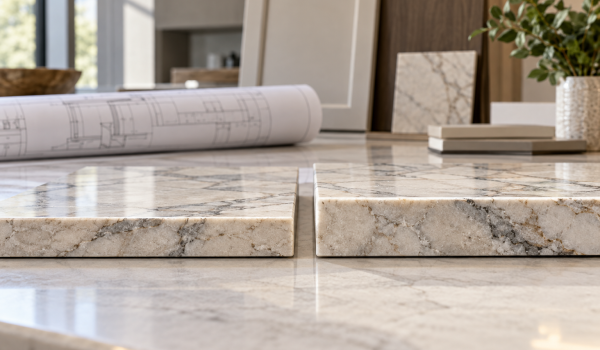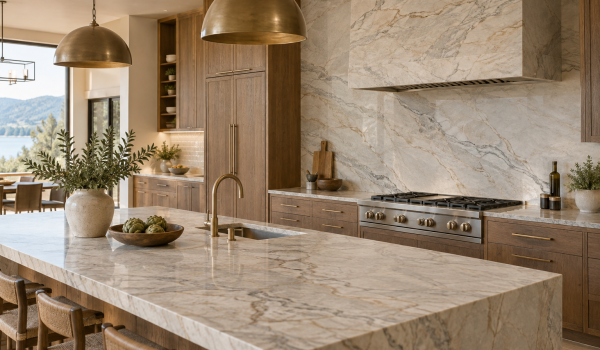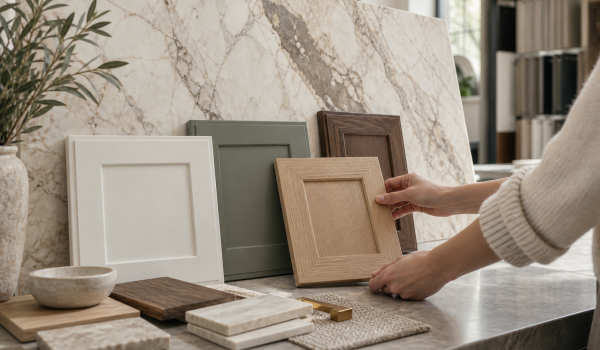
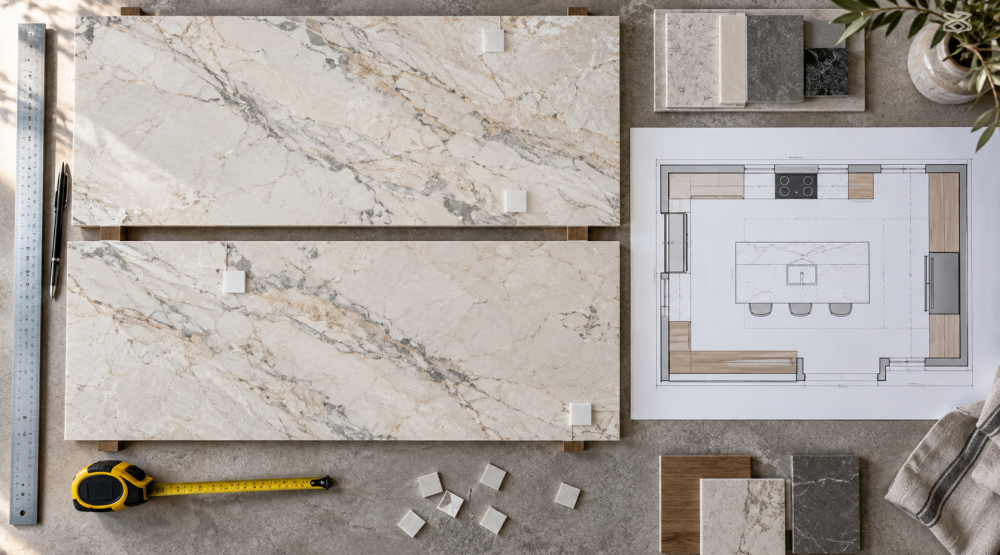
One of the first questions in a countertop project is how many stone slabs the kitchen will require. The answer cannot be determined reliably from countertop square footage alone. Slab dimensions, cabinet layout, cutouts, seams, veining direction, edge details, and special features all affect how much material can actually be used.
Approximate measurements are helpful for early planning, but the fabricator must calculate the final slab quantity from field measurements, the selected material, and an approved layout.
Why Square Footage Is Only the Starting Point
A slab is a large rectangle, while a kitchen is made of runs, corners, islands, sink openings, cooktops, and narrow pieces. Those shapes cannot always be arranged to use every part of the stone.
Natural veining adds another consideration. Rotating a piece might improve material yield, but it may send the pattern in an unwanted direction. Areas with fissures, inclusions, or other natural characteristics may also influence placement depending on the material and application.
Slab Dimensions Vary
There is no single universal slab size. Dimensions vary by stone, block, quarry, and available inventory. Two materials with similar names or colors may offer very different usable areas. That is one reason to inspect the exact natural stone slab in the showroom rather than planning from a sample alone.
Planning should therefore use the measurements of the exact slab or bundle under consideration. Your fabricator will also account for the cutting equipment, edge allowances, and other production requirements relevant to the project.
Kitchen Features That Can Increase Material Needs
Several design choices can increase the amount of stone required even when the countertop footprint remains the same:
- A large or unusually shaped island
- Waterfall panels at one or both ends
- A full-height slab backsplash
- Thick built-up or mitered edge details
- Long countertop runs with limited seam locations
- Bookmatched or carefully vein-matched sections
- Additional surfaces such as a pantry, bar, desk, or window sill
Discuss these features before selecting material. An early conversation may reveal that a coordinating slab pair is more important than choosing a single slab with the perfect center section.
How Seams Affect the Layout
Seam locations influence both appearance and yield. A layout with fewer seams may require longer uninterrupted sections, while a carefully placed seam can sometimes use the slab more efficiently.
The fabricator determines feasible seam locations based on cabinet support, access, transportation, installation conditions, stone characteristics, and the geometry of the room. Visual preferences are important, but they must be balanced with fabrication and installation requirements.
Why Vein Direction Matters
Directional stone needs to be read as a composition. The design may call for movement to travel along a countertop run, turn onto a waterfall edge, or continue up a backsplash. Preserving that direction can limit how pieces are nested on the slab.
If multiple slabs are needed, ask to see coordinating or sequential pieces. Review differences in color and movement, and discuss which sections should appear beside one another.
Who Confirms the Final Number of Slabs?
Your fabricator should provide the final quantity. Showroom staff can help identify available slabs and discuss visual characteristics, but the fabricator is responsible for templating, cut planning, seam placement, production, and installation.
Before material is cut, confirm that the fabricator has the exact slab dimensions and enough information to produce a layout. For highly patterned material, request an opportunity to review the proposed orientation when that service is available.
Plan Before You Reserve Material
Bring preliminary plans and approximate measurements when you begin shopping, especially for projects with a large island, waterfall edges, or a slab backsplash. Once you identify a material, have the fabricator verify the required quantity before finalizing the selection.
Browse Terra Stone Gallery’s current slab inventory and use the stone slab FAQ to prepare for the selection process. For availability and showroom questions, contact Terra Stone Gallery.